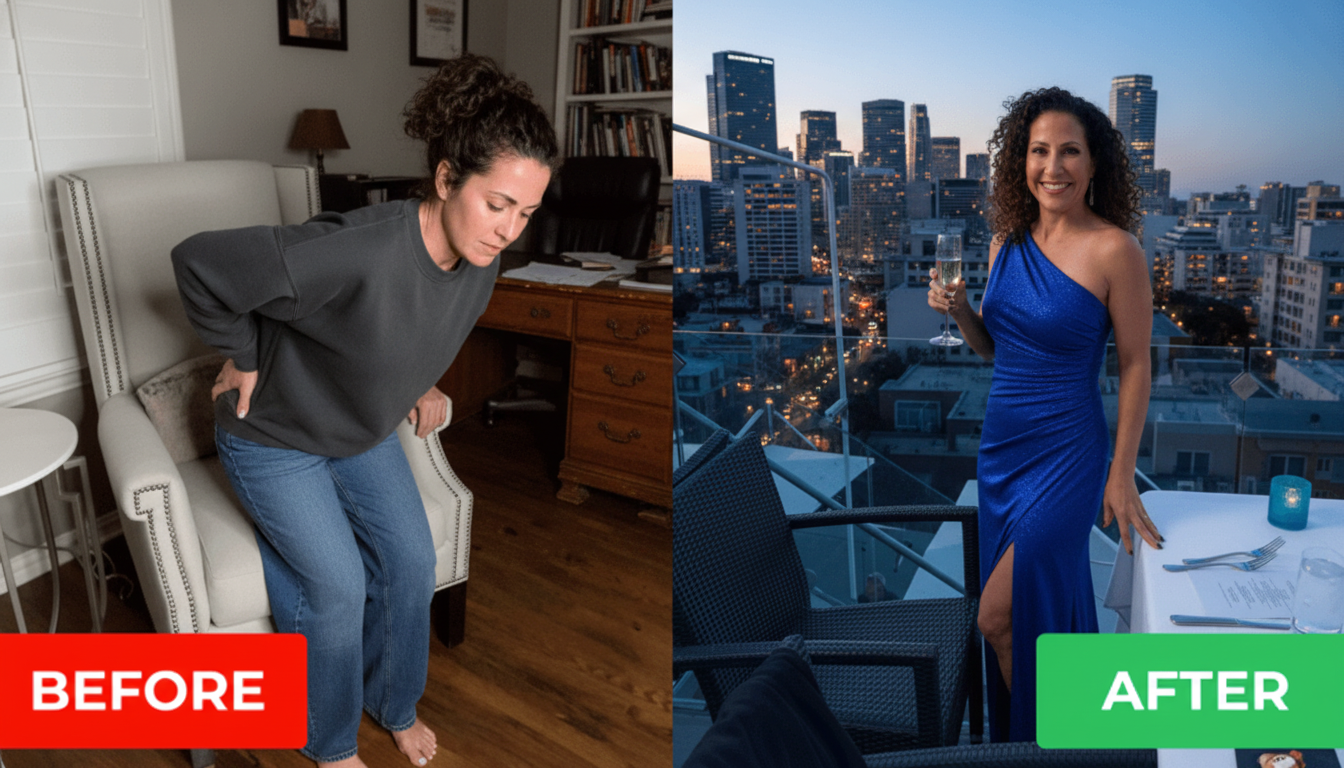
The cruelest part of chronic pain isn't the pain. It's the hope cycle. You hear about a treatment. You let yourself believe. You spend the money. You feel better for a day, a week, maybe two. Then the pain returns — same spots, same intensity — and you have to start hoping again.
I went through that cycle four times. And what I understand now, after everything, is that every single treatment failed for the same reason. Not because the clinicians were incompetent. Because the system pointed them — and me — at only half the problem.
Stay with me. Because if you've tried even one of the four things I'm about to walk you through — and you're still in pain — what I discovered on my living room floor at 11 PM on a Tuesday will change how you think about your body for the rest of your life.
Round one: my own physical therapy protocol. Six weeks of core strengthening and stabilization — the exact program I'd prescribed to hundreds of stenosis patients. The leg symptoms got worse. I was building armor around a fire.
Round two: chiropractic. Twice a week. $65 per session. $520 a month. Each adjustment was technically correct — the vertebrae were realigned. For about 45 minutes, my back felt open. Then, on the drive home, the muscles pulled everything right back. Every time. The same muscles. The same pull.
David stopped asking how the appointment went after month three. He'd be in the kitchen when I came through the door, and he'd look at my face, and he'd know. After a while, he just started having the heating pad plugged in and ready on the couch. No words. Just the pad, waiting.
I was paying $520 a month for adjustments that the muscles undid before I reached my driveway. $6,240 a year. And it never occurred to me — or to the chiropractor — to ask why the muscles kept overriding the correction. We just kept adjusting. The system doesn't ask why the adjustment doesn't hold. The system books the next appointment.
Round three: medication. Ibuprofen, 1,800mg daily. It turned the volume down. The source of the signal remained untouched. After four months: bloating, acid reflux, nausea. My doctor called it "the trade-off" — twenty-eight years in medicine, I'd used that exact phrase with patients. I never heard what it sounded like from the other side.
Round four: epidural steroid injection. $800 after insurance. Eleven days of real relief the kind that makes you remember who you used to be. I walked through the grocery store without stopping once. I stood at the kitchen counter and cooked a full meal. Then, day twelve, I walked Jake to school. By the second block, the heaviness flooded back into both legs like it had never left.
$14,000. Two years. Every treatment aimed at the narrowed canal — or at silencing the pain signal it was sending. Not one had addressed the second layer of compression that was making the stenosis unbearable. And the system that charged me $14,000 had no reason to look deeper — because looking deeper leads to a solution, and solutions end the billing cycle.